
Dreams of Treasure Valley Transit (Pt. 2)
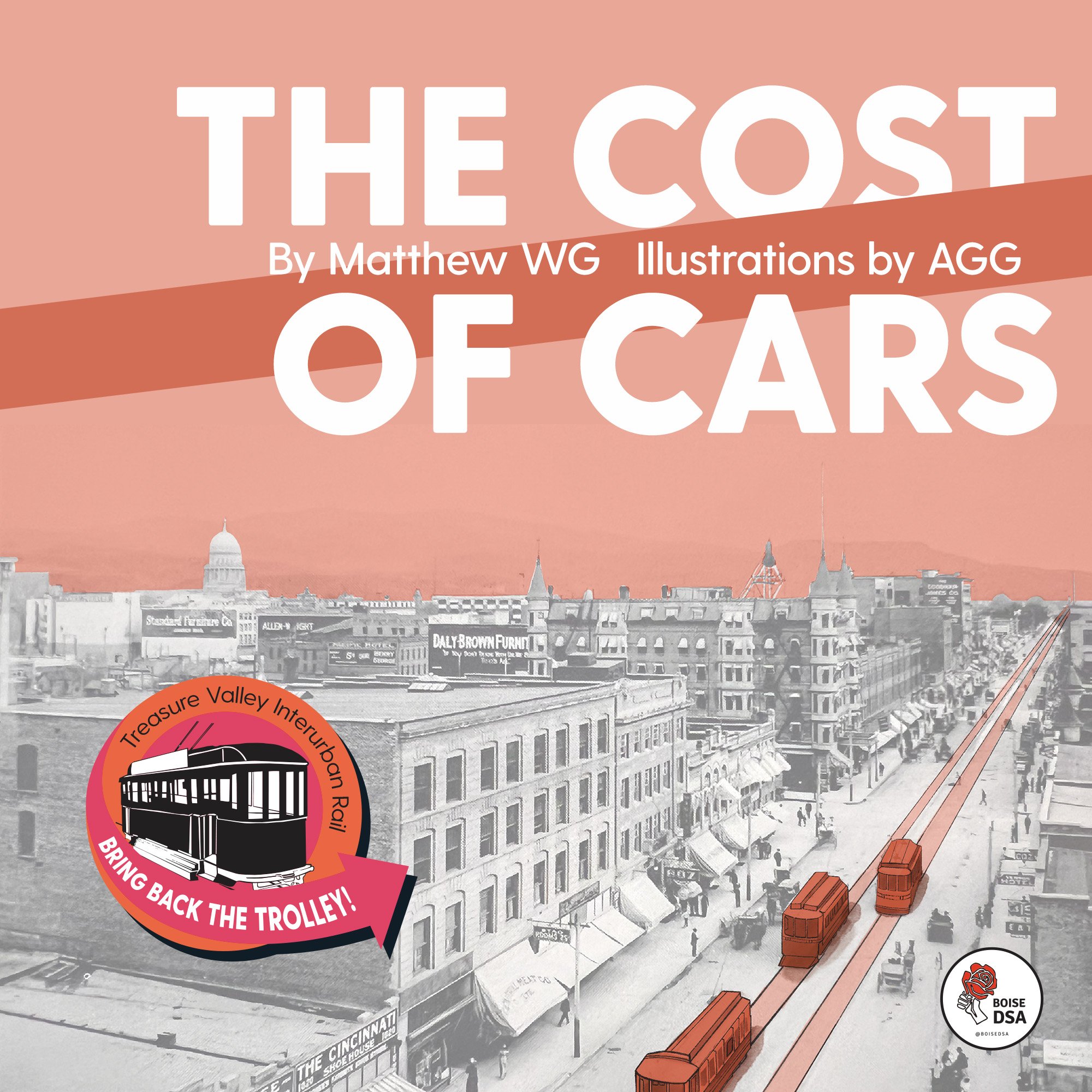
By Matthew WG, Illustration by AGG
The Cost of Cars
Bringing back the trolley will be expensive—more expensive than the first time we did it back in 1892. To build a trolley system that adequately services the Treasure Valley, we’d be looking at a cost of $7-10 billion. And if we want bus routes that get to the main depots (which we do), it will be even more. To understand why this expense makes sense, we have to look at the cost of a car-exclusive transportation system. To understand why we haven’t made this obvious investment in transportation, we have to look at the interests served by the status quo.
In the Treasure Valley we spend a truly unbelievable amount of money every year to drive cars. First, the highway department in all the cities and counties in the Treasure Valley has to build new roads and highways to accommodate a rapidly growing population. This, of course, comes from tax dollars. And as the highway districts build the new roads, they also have to maintain all the roads that have been built in the past. Since our growth pattern has been to spread out rather than build up, our road-to-resident ratio is extremely high. The 2026 budget for ACHD including maintenance and new projects is $372 million.[1] The rest of the highway districts in the Treasure Valley have a combined budget of about $100 million. That’s $472 million a year just for building and maintaining roads.
In addition, many of our neighborhoods have been built by developers who agreed to pave the roads in their developments when they were built, but the city/county agreed to maintain those roads in the future. As those developments age, the bill is coming due for cities and counties who agreed to maintain that infrastructure.[2] So, we’re seeing deteriorating roads, patchwork maintenance, and ballooning costs.
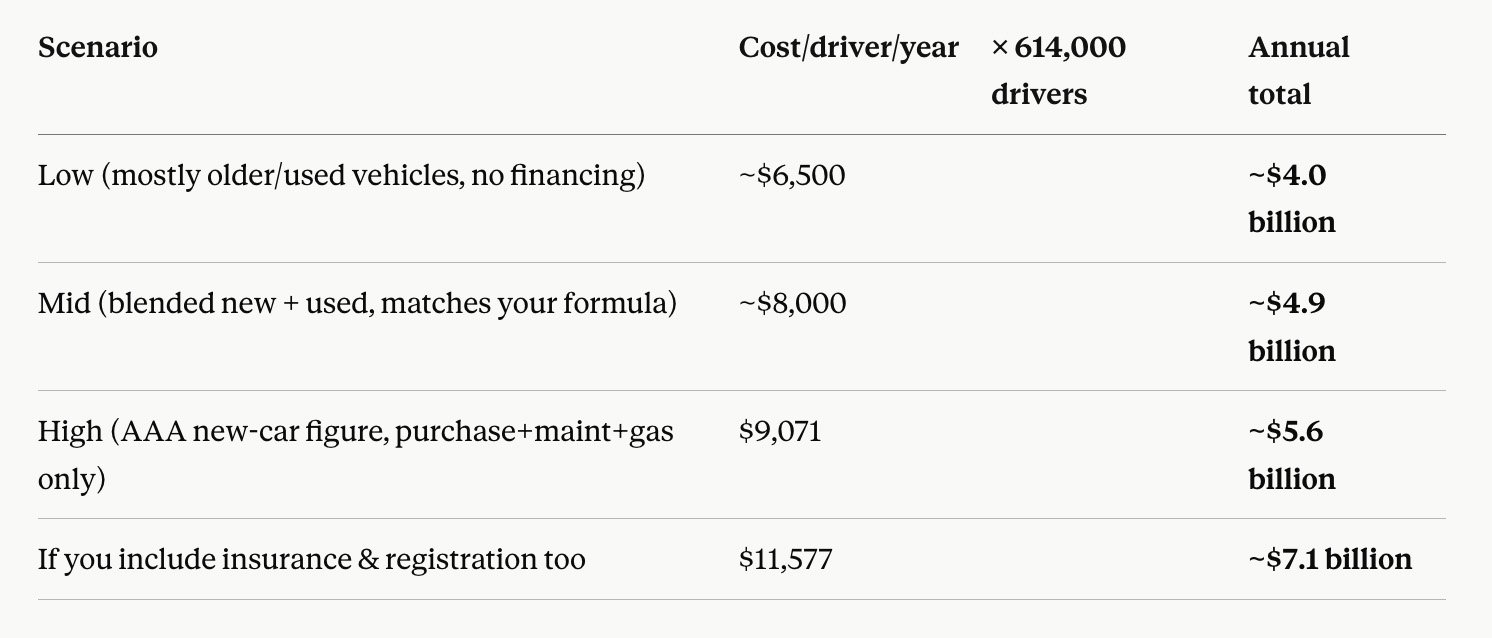
The collective cost of building and maintaining roads is only the beginning. In fact, it’s dwarfed by the amount of money we spend individually to own and maintain cars. If you’re working a job in the Treasure Valley, you are essentially forced to own a car. And when you add up the cost of purchase, licenses and insurance, gas, financing, and maintenance, we spend roughly $7.1 billion a year on car ownership in the Treasure Valley.[3]
Now, we’re at about $7.5 billion a year to have car-exclusive transportation, which is more than the cost of construction for our brand new trolley system. The numbers make sense. But it’s not just money that we spend on cars. What about the time of our lives we spend sitting in cars waiting for traffic so we can get to work, or to an appointment, or to visit a friend? Commuters from Nampa and Caldwell into Boise can expect over an hour sitting in traffic on the way to and from work. That’s over two hours a day to travel 15-20 miles each way. By comparison, if you were riding a bike at a reasonable pace you could make the distance in about the same time. This is because highways just don’t scale well. They’re difficult and expensive to expand, and no matter how many lanes you add, there will be times when some portion bottlenecks and jams up the whole thing. A well-developed trolley system could turn an hour drive in traffic into a 20 minute stress-free ride. The thing about railcars is that the more cars you add, the better it gets. This is because more railcars means that arrivals and departures become more frequent. It scales gracefully where highways devolve into a traffic nightmare.
There are two more areas where cars cost us a lot. Cars cost us a lot of material resources, they generate massive amounts of material waste, and they pollute our air. The cost of cars in terms of resources and pollution is massive for our little valley. Globally, it’s an existential threat. Air quality is strongly linked to health outcomes and medical costs. We die sooner when we are exposed to the fumes that cars put into our air.
And that brings us to the final cost of cars—the cost in human lives. Over the last 20 years, thousands of our friends, neighbors, and family members have died in traffic accidents. Those deaths are avoidable in the future if we can band together and make the dream of bringing back the trolley a reality.
Recently, The U.S. Department of Transportation awarded a grant for a railway feasibility study to the City of Boise.[4] $500,000 to see what it would take to develop a basic trolley system. It’s not the first time such a study has been performed. But every time there seems to be a glimmer of hope for a working public transportation system in the Treasure Valley, it eventually gets buried, squashed, and forgotten. This time will be no different unless we make it different. The Boise DSA is committed to developing a roadmap for a world-class trolley system in the Treasure Valley and working with our fellow residents and any sympathetic organizations to make it a reality.
So what would a modern trolley system look like in the Treasure Valley? How have other cities made this happen while we’re struggling to even maintain bus routes? The final article in this series will paint a picture of what bringing back the trolley could really mean for working people in the Treasure Valley. Bringing back the trolley is something we can do, we should do, and we will do if we can stand in solidarity for our own interests.
Notes:
[1] “Budget (Fiscal Year 2026),” ACHD Engage, August 28, 2025, https://engage.achdidaho.org/budget-fiscal-year-2026.
[2] “Streets,” n.d., Strong Towns, https://www.strongtowns.org/streets.
[3]
[4] “Boise Receives $500,000 Grant to Study Restoration of Passenger Rail”, Jun 24, 2026 , City of Boise, https://www.cityofboise.org/news/general/2026/june/boise-receives-500k-grant-to-study-passenger-rail/.